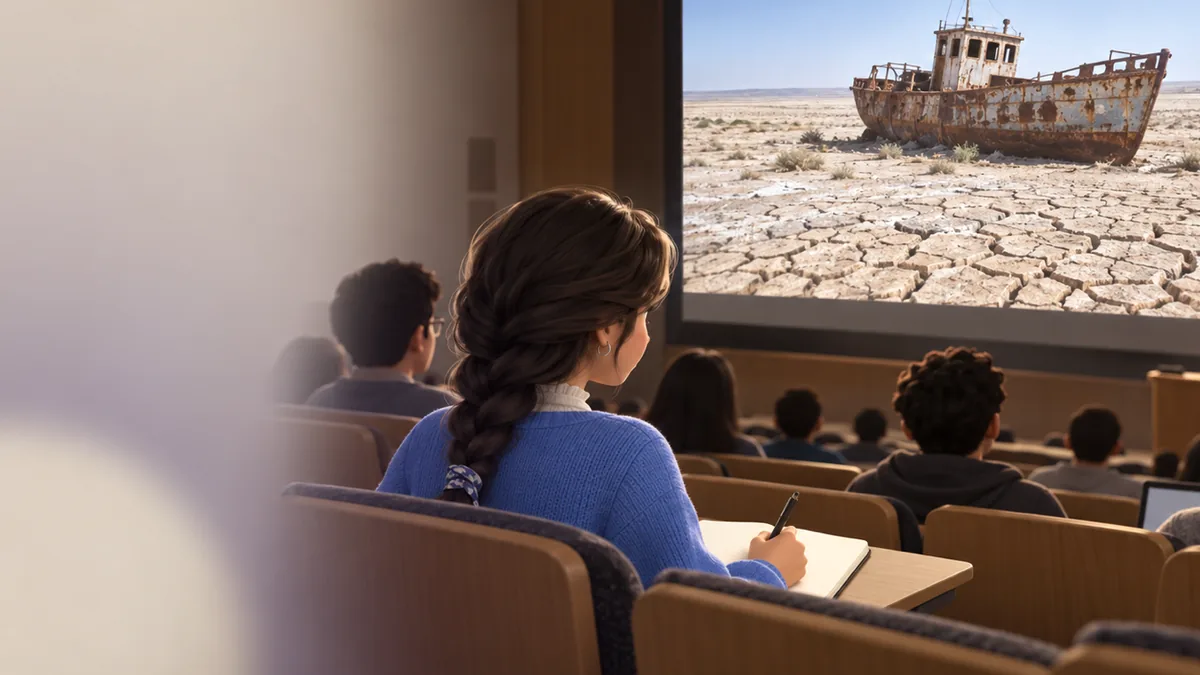
Atrof-muhit savollarining aksariyati sabab → oqibat → yechim zanjirini tekshiradi: muammo nimadan kelib chiqadi, kimga zarar qiladi va kim — davlatmi, kompaniyami yoki oddiy odam — nima qila oladi. Eng ko‘p uchraydigan yo‘nalishlar: iqlim o‘zgarishi, havo ifloslanishi, chiqindi va plastik, suv tanqisligi, energiya manbalari. O‘zbekistonlik nomzodning ustunligi shundaki, eng aniq misol — Orol dengizi, suv va issiqlik — uning o‘z hayotida bor.
Bu sahifada 6 ta mashq savoli, beshta muammo bo‘yicha tayyor zanjirlar, 14 ta collocation, to‘liq namuna esse va reja mashqi bor. Savollar mashq uchun tuzilgan, haqiqiy imtihon savollari emas.
6 ta mashq savoli va imtihonchi nimani kutadi
| # | Mashq savoli | Tur | Nimani unutmaslik kerak |
|---|---|---|---|
| 1 | Fresh water is becoming scarce in many parts of the world. What are the main causes, and what measures could be taken? | Cause–solution | Har yechim bitta sababga javob bersin |
| 2 | Individuals can do little to protect the environment; only governments and large companies can make a real difference. To what extent do you agree? | Opinion | "Faqat" so‘ziga munosabat bildiring |
| 3 | Some people think the best way to reduce plastic waste is to ban plastic bags; others prefer education. Discuss both views and give your opinion. | Discussion | Ikkala qarash, keyin o‘z fikringiz |
| 4 | Air quality in many large cities is getting worse. Why is this happening, and what can be done? | Two-part | Ikki savolga teng javob |
| 5 | Countries should invest in solar and wind power rather than oil and gas. Do the advantages outweigh the disadvantages? | Advantages outweigh | Aniq hukm |
| 6 | Tourism damages the natural environment. What problems does it cause, and how can they be reduced? | Problem–solution | Muammo va yechimni juftlang |
1-savolga namuna pastda. Muammo va yechimni bog‘lashning umumiy qoidasi: IELTS problem–solution essay.
Beshta muammo: sabab–oqibat–yechim zanjirlari
Raqamlar ataylab berilmagan. Aniq ko‘rsatkichni bilmasangiz, a considerable share, in many areas kabi ehtiyotkor ifodalar ishlating.
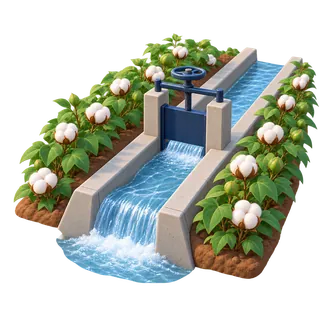
Suv tanqisligi. Sabab: ochiq kanallar orqali sug‘orish, eskirgan quvurlar, arzon suv. Oqibat: daryolar sayozlashadi, Orol dengizi 1960-yillardan boshlab daryolar sug‘orishga burilgach keskin qisqargan. Yechim: tomchilatib sug‘orish, quvurlarni ta’mirlash, pog‘onali tarif.
Havo ifloslanishi. Sabab: avtomobillar soni, qurilish changi, qishda isitish. Oqibat: nafas yo‘li kasalliklari, Toshkentda qish kunlari havo sifati ko‘pincha muhokama qilinadi. Yechim: jamoat transporti, qurilish maydonlarida chang nazorati, daraxt ekish.
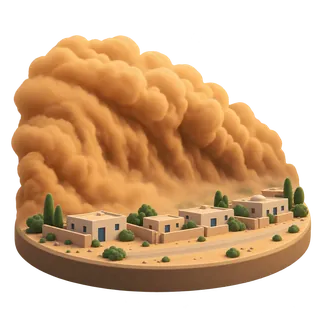
Cho‘llanish va chang bo‘ronlari. Sabab: qurib qolgan dengiz tubi, yaylovlardan ortiqcha foydalanish. Oqibat: tuz va chang yaqin hududlarga tarqaladi, ekin yerlari buziladi. Yechim: qurigan Orol tubiga saksovul ekish kabi loyihalar, yaylovlarni navbat bilan ishlatish.
Chiqindi va plastik. Sabab: bir martalik qadoqlar, chiqindini saralash odati yo‘qligi. Oqibat: poligonlar to‘ladi, ariqlar ifloslanadi. Yechim: saralash konteynerlari, qayta ishlashga rag‘bat, mahalla darajasida tushuntirish.
Energiya. Sabab: elektr va issiqlikka talab o‘smoqda. Oqibat: gaz va ko‘mirga bog‘liqlik, havo ifloslanishi. Yechim: quyosh va shamol elektr stansiyalari (O‘zbekistonda so‘nggi yillarda bunday loyihalar qurilmoqda), binolarda issiqlikni tejash; "Yashil makon" kabi daraxt ekish tashabbuslari shahar va qishloqlarni ko‘kalamzorlashtirishga qaratilgan.
Atrof-muhit mavzusi uchun 14 ta collocation





| Collocation | Tarjima | Misol gap |
|---|---|---|
| water scarcity | suv tanqisligi | Water scarcity threatens farming in dry regions. |
| drip irrigation | tomchilatib sug‘orish | Drip irrigation delivers water straight to the roots. |
| greenhouse gas emissions | issiqxona gazlari chiqindilari | Power stations are a major source of greenhouse gas emissions. |
| fossil fuels | qazilma yoqilg‘i | Many countries still depend on fossil fuels. |
| renewable energy | qayta tiklanadigan energiya | Solar panels are one form of renewable energy. |
| reduce your carbon footprint | uglerod izini kamaytirmoq | Using public transport reduces your carbon footprint. |
| single-use plastic | bir martalik plastik | Single-use plastic ends up in rivers and canals. |
| drop litter | axlat tashlamoq | People who drop litter should be fined. |
| landfill site | chiqindi poligoni | Landfill sites near cities are almost full. |
| deforestation | o‘rmonlarning kesilishi | Deforestation increases the risk of floods. |
| an ecological disaster | ekologik falokat | The shrinking of the Aral Sea is often called an ecological disaster. |
| take urgent action | zudlik bilan chora ko‘rmoq | Governments must take urgent action on air quality. |
| raise public awareness | jamoatchilik xabardorligini oshirmoq | Schools can raise public awareness of recycling. |
| environmentally friendly | ekologik toza | Electric buses are more environmentally friendly. |
Namuna esse: suv tanqisligi (cause–solution)
Mashq namunasi — rasmiy ball emas. Savol: jadvaldagi 1-savol.
In many regions, including Central Asia, rivers are carrying less water and underground supplies are falling, while demand from farms, industry and growing cities continues to rise. In my view, the main causes are wasteful irrigation and poorly maintained water systems, and the most effective measures are modern irrigation methods and fairer pricing.
The largest cause is the way water is used in agriculture. In many dry countries, fields are still flooded through open channels, so a considerable share of the water evaporates or soaks away before it reaches the plants. The fate of the Aral Sea shows how serious the consequences can be: after its feeder rivers were diverted to irrigate cotton fields from the 1960s onwards, the sea shrank dramatically, and dust from its dry bed now affects nearby communities. A second cause lies in cities, where old pipes leak and water is often so cheap that households have little reason to save it.
Each cause points to a solution. Farmers could switch to drip irrigation, which delivers water directly to the roots, but because the equipment is costly, governments would need to offer loans or subsidies, particularly to small farms. Growing less thirsty crops in the driest areas would also help. In cities, replacing leaking pipes should be a priority, and a tiered tariff, in which a basic amount of water stays cheap while heavy use costs more, would encourage saving without harming poorer families.
In conclusion, fresh water is becoming scarce mainly because it is used inefficiently on farms and wasted in urban systems. Modern irrigation supported by public funding, together with repaired networks and fair pricing, offers the most realistic way to protect this resource.
(Taxminan 290 so‘z.)
Tahlil: kirish ikki sabab va ikki yechimni oldindan aytadi. 2-paragrafdagi Orol misoli umumiy ma’lum fakt, raqamsiz. 3-paragrafdagi har yechim aniq sababga javob beradi va uning kamchiligi (uskunaning qimmatligi) ham hisobga olingan. Kirishni qanday qisqa va aniq yozish haqida: IELTS essay introduction.
Ekologiya ≠ environment: mavzudagi so‘z xatolari
| Xato | To‘g‘ri | Izoh |
|---|---|---|
| The ecology in our city is bad. | Our city has serious environmental problems. | Rus tilidagi экология ma’nosida ecology ishlatilmaydi; ecology — fan nomi |
| We must save the nature. | We must protect nature / the environment. | Nature artiklsiz; the environment artikl bilan |
| People throw rubbish to the street. | People drop litter in the street. | Tayyor birikma |
| Global warming is the biggest problem of all humanity. | Climate change is one of the most serious problems facing the world. | Mutlaq da’vodan qoching |
| Factories make pollution. | Factories cause / produce pollution. | To‘g‘ri fe’l |
| Government must ban all cars. | The government could restrict cars in the city centre. | Artikl va real yechim |
Reja mashqi: zanjirni to‘ldiring
4-savol uchun (Air quality in many large cities is getting worse. Why is this happening, and what can be done?) jadvalni daftarga ko‘chiring va to‘ldiring: har sabab uchun bitta aniq oqibat va unga mos bitta yechim.
| Sabab | Oqibat | Yechim |
|---|---|---|
| 1. Shaxsiy avtomobillar ko‘payishi | ? | ? |
| 2. Qurilish changi | ? | ? |
| 3. Qishda uylarni isitish | ? | ? |
So‘ngra 1–2 gapli thesis yozing.
Namuna javoblar
- 1. Avtomobillar: oqibat — tirbandlik paytida chiqindi gazlar ko‘payadi, yo‘l bo‘yidagi maktab va uylarga ta’sir qiladi. Yechim — metro va avtobuslarni qulay qilish, markazda to‘xtash joyini qimmatlashtirish.
- 2. Qurilish changi: oqibat — qurilish yaqinida yashovchilarning nafas olishi qiyinlashadi. Yechim — maydonni to‘siq bilan o‘rash, quruq kunlarda suv sepish, qoidabuzarlarga jarima.
- 3. Isitish: oqibat — qish oylarida havo sifati eng yomon bo‘ladi. Yechim — binolarni issiqlik izolyatsiyasi bilan ta’mirlash, toza isitish tizimlariga o‘tish.
- Thesis namunasi: Urban air is getting worse mainly because of growing car use, dust from construction and winter heating, and the most effective response is to make public transport more attractive while enforcing stricter rules on building sites.
Uchta sababdan ikkitasini tanlasangiz ham bo‘ladi: har biri to‘liq ochilgan ikki paragraf uchta yuzaki paragrafdan kuchliroq. Xuddi shu g‘oyalar og‘zaki savollarda ham kerak bo‘ladi: IELTS Speaking environment savollari. Sog‘liq bilan bog‘liq savollar (masalan, havo va kasalliklar) uchun IELTS Writing health topic sahifasiga o‘ting.
Sabab va yechimni Bandi bilan og‘zaki bog‘lash
BandMate ilovasida Bandi’ga 4-savolni bering va har sababni "because… so…" tuzilmasi bilan tushuntiring; u "what exactly would that change?" kabi qayta savollar beradi. Og‘zaki zanjir tayyor bo‘lsa, paragraf tez yoziladi. Ilova talaffuz va grammatika bo‘yicha fikr beradi, lekin Writing bandini baholamaydi.