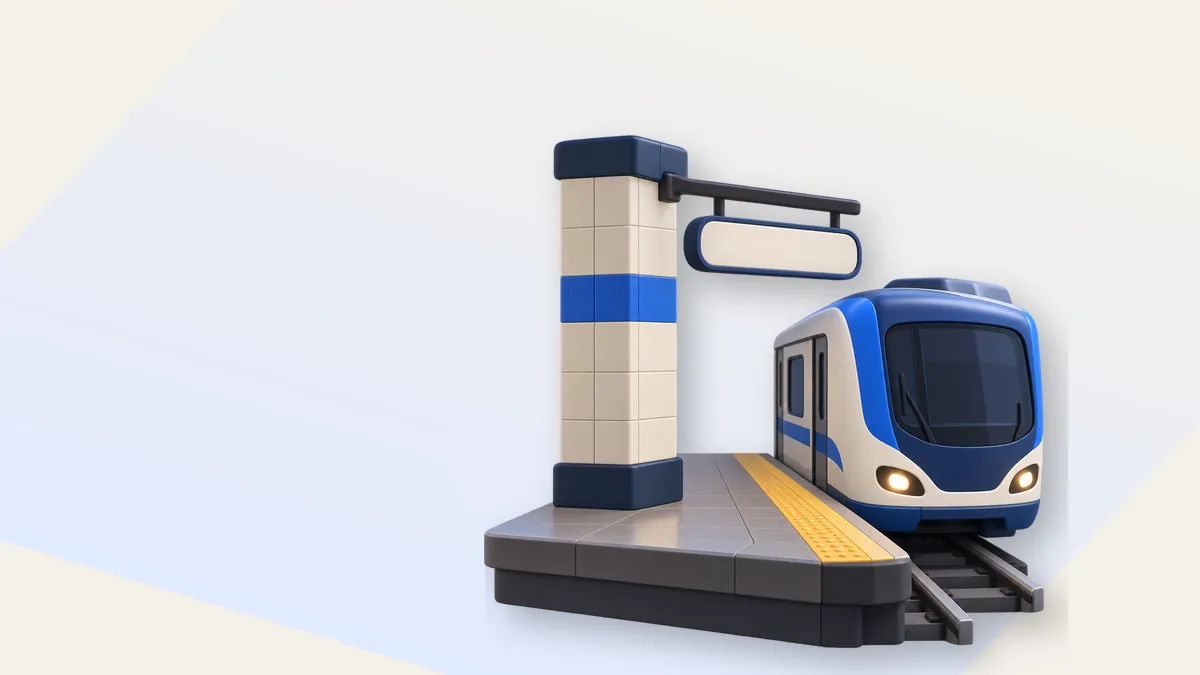
A good description of Tashkent answers three questions: what kind of city it is, what it looks like and what you personally like or dislike. For example: Tashkent is the capital of Uzbekistan and a big, green, fast-changing city. Most of the centre was rebuilt after an earthquake in 1966, so you see wide avenues, Soviet-era buildings and new glass towers side by side. My favourite thing is the metro: it's cheap, quick, and some stations look like museums.
Below are the words you need, three model texts at A2, B1 and B2, short explanations of landmarks and districts, and practice questions in the style of IELTS Speaking.
City words for talking about Tashkent
| English | Uzbek | Example |
|---|---|---|
| capital | poytaxt | Tashkent is the capital of Uzbekistan. |
| district | tuman | I live in Chilonzor district. |
| neighbourhood | mahalla, atrof | It's a quiet neighbourhood with a lot of trees. |
| residential area | turar-joy hududi | Yunusobod is mainly a residential area. |
| high-rise | ko‘p qavatli bino | New high-rises are going up everywhere. |
| block of flats | ko‘p qavatli uy | We live in a nine-storey block of flats. |
| landmark | diqqatga sazovor joy | The TV Tower is a landmark you can see from far away. |
| square | maydon | Amir Temur Square is in the very centre. |
| monument | yodgorlik | There's a monument to Amir Temur on horseback. |
| avenue | keng ko‘cha, shoh ko‘cha | The avenues in the centre are very wide. |
| pedestrian street | piyodalar ko‘chasi | Broadway is a pedestrian street with artists and cafés. |
| bazaar | bozor | Chorsu is the most famous bazaar in the city. |
| old town | eski shahar | The old town has narrow streets and mosques. |
| business district | biznes markaz | Tashkent City is the new business district. |
| metro station | metro bekati | The nearest metro station is a five-minute walk away. |
| traffic jam | tirbandlik | There are traffic jams in the evening rush hour. |
| fountain | favvora | In summer, children play near the fountains. |
| suburbs | shahar chekkasi | More people are moving to the suburbs. |
Adjectives that describe Tashkent better than beautiful: green (lots of trees and parks), spacious (wide streets), sprawling (spread over a large area), bustling (busy and full of life), fast-changing, affordable, hot and dusty in summer, crowded at rush hour.
Model text 1: A2 (about 60 words)
I live in Tashkent. It is the capital of Uzbekistan and a very big city. My home is in Chilonzor, near a metro station. Every day I go to university by metro because it is fast and cheap. At the weekend I often walk in the park with my friends. I like Tashkent because it is green and friendly, but the summer is too hot.
What makes it work: simple present tense, one personal routine, one reason, and one small negative (the summer is too hot).
Model text 2: B1 (about 100 words)
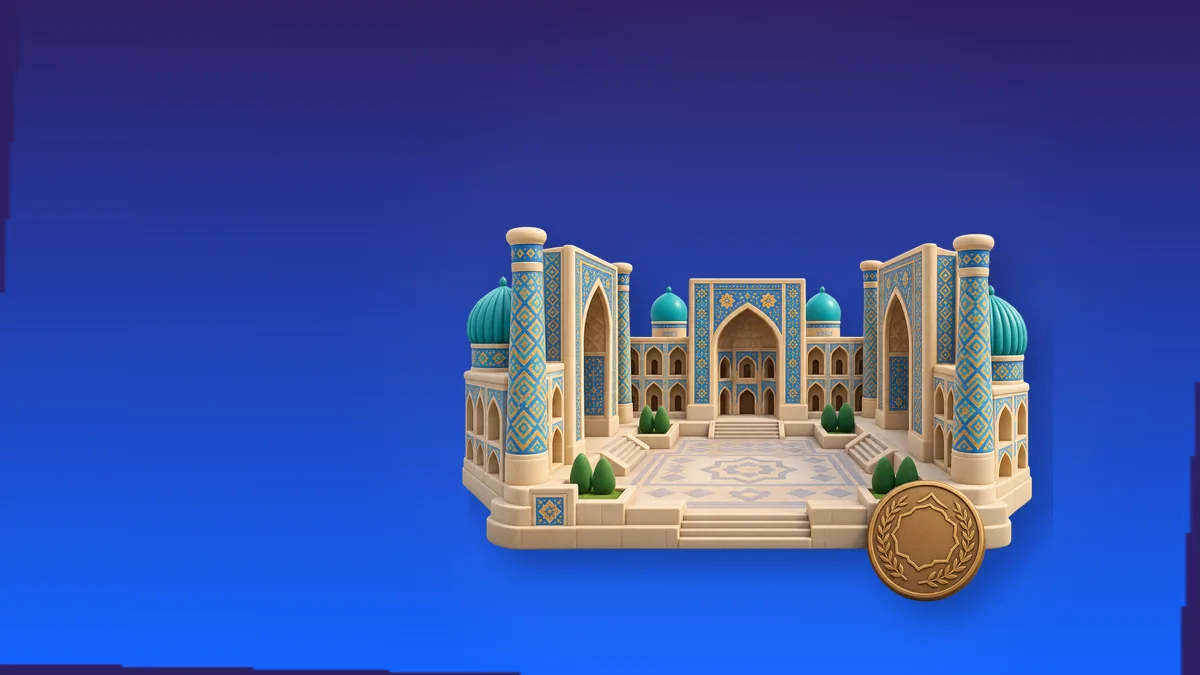
If a friend visited me in Tashkent, I would start at Chorsu Bazaar in the morning, when it's busy and noisy. You can buy fresh bread, dried fruit and spices there, and the building itself has a huge blue dome. Nearby is the old town, with narrow streets and the Khast Imam complex. After lunch, I'd take the metro to Amir Temur Square and walk along Broadway, where artists sell paintings. In the evening, the new Tashkent City park is lit up with fountains and lights. It's a city of contrasts: old and new, quiet and bustling.
Language to notice: the second conditional for a hypothetical visit (If a friend visited, I would…), where to add detail, and a closing summary sentence.
Model text 3: B2 (about 150 words)
What strikes most visitors is that Tashkent doesn't look like the Silk Road postcard they expected. That's partly history: after the 1966 earthquake, much of the centre was rebuilt in a bold modernist style, with concrete facades decorated with local patterns. For a long time, locals saw these buildings as simply "Soviet". Recently, though, attitudes have shifted, and in 2026 UNESCO added ten of them, including Chorsu Bazaar and Kosmonavtlar metro station, to the World Heritage List.
At the same time, the city is changing incredibly fast. Whole neighbourhoods of low houses have been replaced by high-rises, and new metro lines are reaching districts that used to feel far away. Not everyone is happy about it: some people miss the old courtyards and shady streets. Personally, I think the challenge is to grow without losing the green, walkable character that makes Tashkent pleasant to live in.
Why it scores higher: a present perfect for change (have been replaced), a passive (was rebuilt), a contrast linker (though, at the same time), a verified fact and a balanced personal opinion.
For the same approach applied to a small town or another city, the Uzbek-language page My city ingliz tilida has texts about Namangan and Samarkand too.
Landmarks in one sentence each
| Place | How to explain it |
|---|---|
| Chorsu Bazaar | A huge market under a blue dome, in the old part of the city; it has been on the UNESCO list since 2026. |
| Khast Imam complex | A group of mosques and madrasas; its library keeps a very early Quran manuscript. |
| Amir Temur Square | The central square, with a statue of Amir Temur on horseback. |
| Independence Square | A large square with government buildings and fountains, where official celebrations take place. |
| Tashkent metro | Opened in 1977, the first metro in Central Asia; many stations are richly decorated. |
| Kosmonavtlar station | A metro station decorated on a space theme, now a UNESCO-listed building. |
| Tashkent TV Tower | A very tall tower with a viewing platform; you can see it from most of the city. |
| Alisher Navoi Theatre | The main opera and ballet theatre, in the city centre. |
| Broadway (Sayilgoh Street) | A pedestrian street with artists, cafés and street musicians. |
| Tashkent City | A new business district with a park, hotels and office towers. |
Keep numbers out of casual descriptions unless you've just checked them; heights and population figures change or get quoted wrongly.
Where you live: talking about districts
Foreigners don't know district names, so add a short description:
- I live in Chilonzor, a big residential district in the south-west, full of Soviet-era blocks of flats.
- My family lives in Yunusobod, in the north. It's newer and quieter.
- I grew up in the old town, near Chorsu, where the streets are narrow and everyone knows each other.
- We moved to Sergeli, in the south. It used to be the edge of the city, but now it's growing fast.
Useful structure: It used to be…, but now…. It's natural, and it shows grammar range.
IELTS-style practice questions
These are practice questions in the style of the test, not official IELTS questions.
Part 1:
- Where are you from?
- What do you like most about your city?
- Is it a good place for young people?
- How do people usually travel around your city?
- Has your city changed much since you were a child?
Sample answer to the last one: Yes, a lot. When I was little, our street had only one-storey houses with gardens. Now there are three twelve-storey buildings there, and a new metro station. It's more convenient, but I miss the trees.
Part 2 (practice cue card): Describe a place in your city that you like to visit. You should say where it is, what you can do there, who you go there with, and explain why you like it.
Quick plan for Tashkent: place (the Botanical Garden, Broadway, Magic City, a choyxona), two details you can see or hear, one memory, one feeling. More strategies are in the IELTS place cue card guide.
Part 3:
- Why do people move from villages to big cities?
- What are the disadvantages of living in a capital city?
- Should old buildings be protected or replaced?
Sample answer to the third: I think it depends on the building. Some old buildings are part of a city's identity. In Tashkent, for example, many people used to think the 1970s buildings were ugly, but now they're internationally recognised. So I'd say we should be careful before demolishing anything, because once it's gone, it's gone.
Six slips in descriptions of Tashkent
| Wrong | Right |
|---|---|
| Tashkent is capital of Uzbekistan. | Tashkent is the capital of Uzbekistan. |
| It is very big and beautiful city. | It's a very big, green city. |
| There are many sightseeings. | There are many sights. / There's a lot to see. |
| It is the most modern city of Central Asia. | …one of the most modern cities in Central Asia. |
| Many new buildings are building now. | Many new buildings are being built. |
| I live in Chilonzor, it is far from centre. | I live in Chilonzor, which is far from the centre. |
Exercise
Complete with one word: used, being, the, sights, which, jams.
- Tashkent is ___ capital of Uzbekistan.
- A new metro line is ___ built near my house.
- Our street ___ to be very quiet.
- There are a lot of ___ in the old town.
- I live in Yunusobod, ___ is in the north of the city.
- There are traffic ___ at rush hour.
Answers
- the; 2. being; 3. used; 4. sights; 5. which; 6. jams.
For a whole-country answer, go back to Describe Uzbekistan in English; for the customs you'll mention when guests visit, see Uzbek traditions in English.
Say your Tashkent description aloud
Describing your city is one of the most common speaking tasks, and it's easy to rehearse. In BandMate, you can answer hometown questions and a practice cue card with Bandi, then get feedback on fluency, vocabulary and pronunciation of words like district, landmark and architecture. The feedback is for practice, not an official score.
Sources
- UNESCO World Heritage Centre: Tashkent Modernist Architecture. Modernity and Tradition in Central Asia
- Gazeta.uz: ten Tashkent modernist buildings added to the UNESCO list (July 2026)