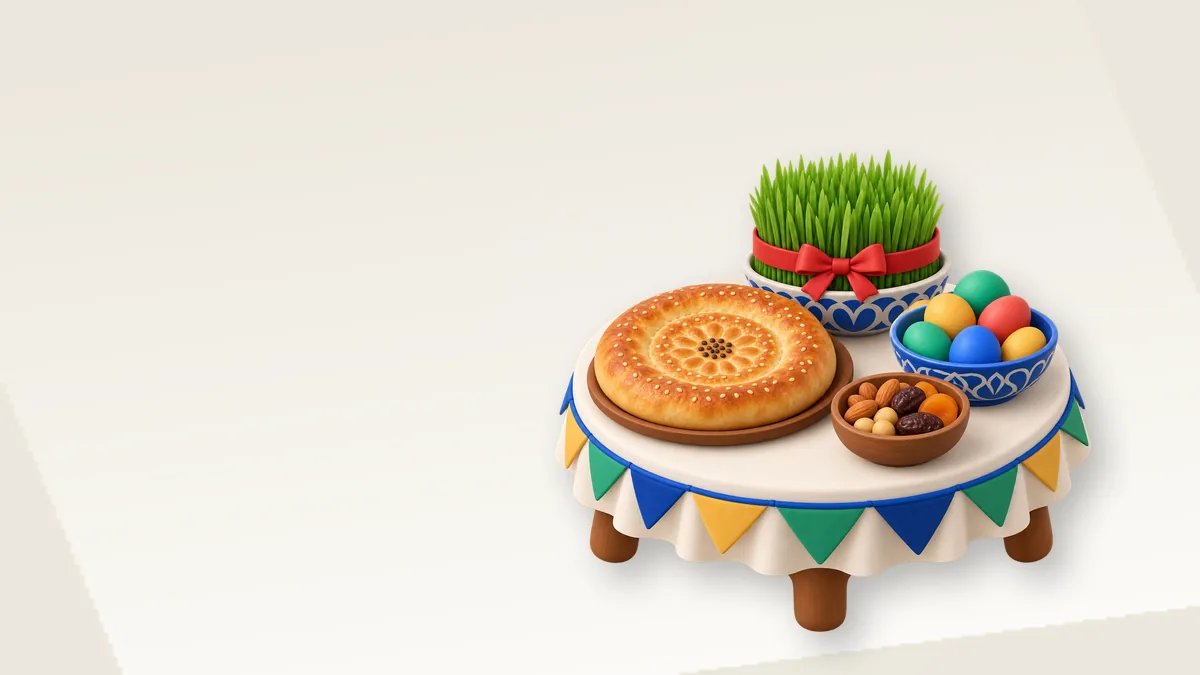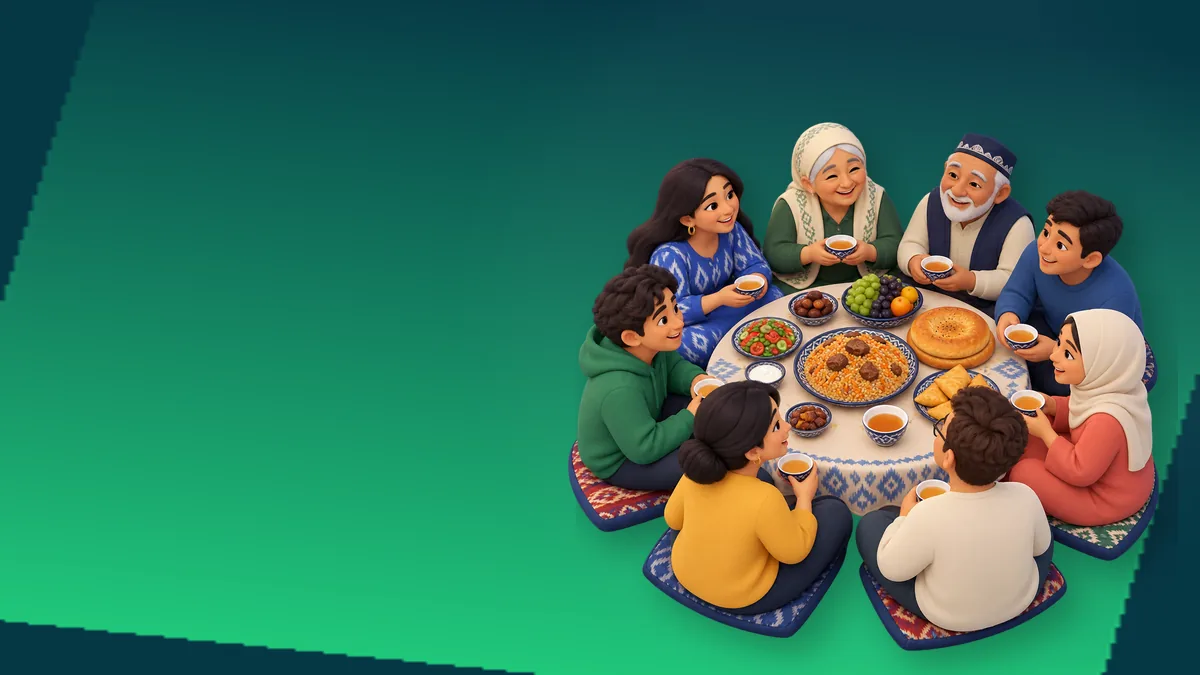
To explain any Uzbek tradition in English, use three moves: keep the Uzbek word and add a short explanation (a dastarkhan, the tablecloth where the whole meal is served), say what people actually do, and say why it matters. For example: In Uzbekistan, a guest is never left without tea. The host pours only half a cup, so that he can keep refilling it, and every refill is a small way of saying "stay longer".
That is the whole method. Below you'll find the words that have no exact English equivalent, phrases for when you are the host, and model paragraphs about hospitality, tea, weddings and the mahalla at B1 and B2 level.
14 words to keep in Uzbek, and how to explain them
Foreigners enjoy learning a few local words, so don't replace them with a weak English approximation. Say the word once, then explain it.
| Uzbek word | Short English explanation | Example sentence |
|---|---|---|
| mehmon | a guest, treated with great honour | There's a saying that a guest is more important than your own father. |
| dastarkhan | the tablecloth and everything served on it | Before you arrive, the dastarkhan is already full of bread, fruit and sweets. |
| non | round flat bread, often stamped in the middle | Non is never cut with a knife at home; we break it by hand. |
| piyola | a small handleless tea bowl | Tea is drunk from a piyola, not a mug. |
| choynak | a teapot | The host pours tea back into the choynak three times before serving. |
| choyxona | a traditional teahouse, often with plov | Men meet at the choyxona to talk and eat. |
| to‘r | the seat of honour, farthest from the door | The oldest guest always sits at the to‘r. |
| mahalla | a neighbourhood community with its own elected committee | Our mahalla helps every family with weddings and funerals. |
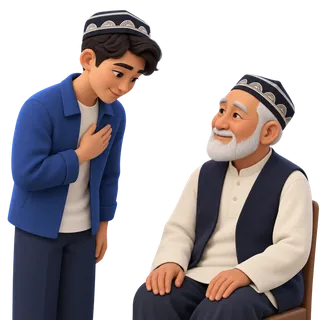
| oqsoqol | a respected elder (literally "white beard") | The oqsoqol opens the meeting with a short prayer. |
| hashar | voluntary community work | On Sunday the whole street did a hashar to repair the road. |
| to‘y | a big family celebration, usually a wedding | A to‘y can have several hundred guests. |
| fotiha | the formal blessing when two families agree to a marriage | After the fotiha, the families start planning the wedding. |
| nahorgi osh | the morning plov served to men before a wedding | Nahorgi osh starts very early, sometimes before sunrise. |
| kelin salom | the new bride's bow to relatives the day after the wedding | At kelin salom, the bride bows to each guest as their name is called. |
Three useful frames for explaining words:
- It's a kind of…, but…: It's a kind of teahouse, but people also eat there.
- The closest English word is…, but it's not quite the same.
- Literally it means…: Oqsoqol literally means "white beard".



Hospitality: what happens when a guest arrives
The typical order of a visit, in simple English you can use right away:
- You take your shoes off at the door. The host will give you slippers.
- The host invites you to sit at the place of honour, far from the door.
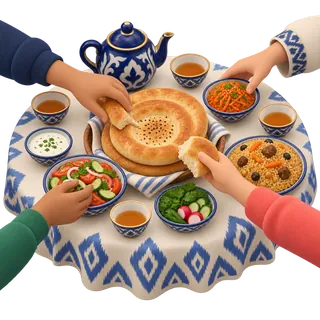
- The table is already set: bread, sweets, dried fruit, nuts and tea.
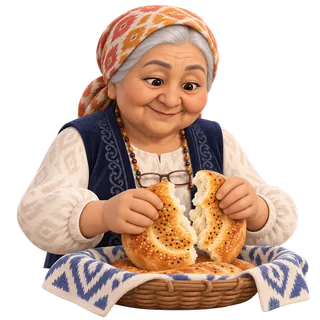
- Someone breaks the bread by hand and puts pieces in front of everyone.
- You drink tea and talk first. The hot meal, often plov or shurpa, comes later.
- At the end, someone says a short blessing, and people make a small gesture with open hands.
B1 model paragraph:
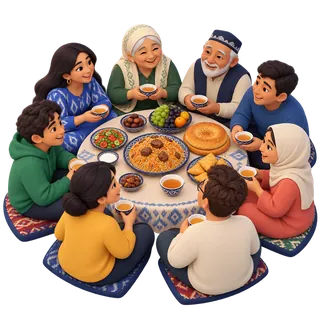
Uzbek people love having guests. When a guest comes, the family puts everything they have on the table: bread, fruit, sweets and tea. The guest sits in the best place, and the hosts serve him all evening. Nobody asks "Do you want tea?" because the answer is always yes. Even if you visit for five minutes, you will get tea and bread.
Phrases for the host (useful when foreign colleagues visit your home):
- Come in, please. Make yourself at home.
- Please sit here. This is the seat for our guest.
- Help yourself. Don't wait for anyone.
- Try this. My mother made it this morning.
- You don't have to finish everything. We always put too much on the table.
- You don't need to take your shoes off if you're uncomfortable.
A cultural note worth explaining to visitors: bread is treated almost as sacred. People don't put non upside down, don't step over it and don't throw it away. Explaining this shows that hospitality is about respect, not only food.
Tea culture: the half-full piyola
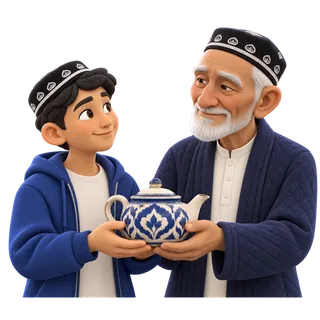
Tea is the backbone of every visit. The host pours a little tea into a piyola and back into the pot, usually three times, so that it brews evenly. Then the tea is served half full, never to the brim.
B2 model paragraph:
Visitors are often surprised that their tea bowl is only ever half full. It isn't stinginess; it's the opposite. A half-full piyola cools down quickly, so you can drink it comfortably, and it means the host has to keep refilling it, which shows constant attention. A full bowl, in some families at least, is a gentle hint that it's time to go home. The host also passes the piyola with the right hand, often with the left hand on the chest, and in many families the youngest person at the table is the one who pours.
Useful verbs: pour, refill, brew, sip. For the food served with tea, see Uzbek food in English.
Weddings: a celebration in several stages
An Uzbek wedding is not a single day, and that's the first thing to explain. A short sequence you can learn:
- Matchmaking and fotiha. First the families meet and agree. At the fotiha, they bless the future marriage and share bread.
- Nahorgi osh. On the wedding morning, men gather very early for plov, often cooked in huge cauldrons.
- Nikoh and registration. The religious ceremony is usually small and private; the civil registration is official.
- The to‘y. In the evening there is a big party with music, dancing and a lot of food.
- Kelin salom. The next morning, the bride greets the groom's relatives with a bow.
B2 model paragraph:
If you're invited to an Uzbek wedding, be ready for scale. Guest lists of several hundred are normal, because it's not only the couple's friends who come but the whole extended family, colleagues and half the mahalla. The evening feels more like a festival than a ceremony: there's live music, a lot of dancing, and plates keep arriving until late at night. For many families it's the most important event they'll ever organise, which is why weddings are planned, and often saved for, for years.
For wedding vocabulary with Uzbek explanations, the page on to‘y so‘zlari inglizcha goes deeper. A foreign guest at a wedding also needs small talk; there's a full wedding dialogue in Small talk in English.
The mahalla: explaining a word English doesn't have
Neighbourhood is too weak, and community is too vague. A mahalla is a neighbourhood that also works as a small social institution, with an elected committee and respected elders.
B1 model paragraph:
I live in a mahalla in Tashkent. A mahalla is like a big family of neighbours. Everybody knows everybody. When a family has a wedding, neighbours help to cook and set up tables. When somebody is ill, people visit and bring food. The older people in the mahalla give advice, and young people help them.
B2 model paragraph:
The closest English translation of mahalla is "neighbourhood community", but that misses how much it does. It has its own committee, which deals with practical things like local repairs and social support, and its elders are still consulted when a family faces a difficult decision. The best example of how it works is a hashar: a weekend when neighbours repair a road or plant trees together, for free. The downside, some younger people would say, is that everyone knows your business.
Mentioning one downside, as in the last sentence, makes an answer sound more balanced.
Navruz in two sentences, and what UNESCO recognises
Navruz is the spring new year on 21 March. Families cook sumalak overnight, visit elders and share food with neighbours. For the full vocabulary and model talks, see Navruz in English.
If you want to add a verified fact, UNESCO's intangible heritage lists include Palov culture and tradition (inscribed for Uzbekistan in 2016), Navruz (shared by a group of countries), Khorazm dance, Lazgi (2019), Shashmaqom music (2008), Askiya, the art of wit (2014) and the Margilan centre that protects atlas and adras weaving (a good safeguarding practice, 2017). Weddings, tea customs and the mahalla are not on those lists, so don't claim they are.
Slips that make explanations sound flat
| Instead of | Say |
|---|---|
| Uzbek people are very hospitable. (and nothing else) | Even a five-minute visit comes with tea and bread. |
| We have national clothes. | We have traditional clothes, like the chapan and the doppi. |
| Guest is king. | Guests are treated with great honour. |
| In our tradition we must… | Traditionally, people… / It's customary to… |
| We respect elders very much. | The oldest person always sits at the seat of honour and is served first. |
| Mahalla is like neighbours. | A mahalla is a neighbourhood community with its own committee. |
One concrete action says more than an adjective. For a broader country description, see how to describe Uzbekistan in English.
Exercise: complete the explanations
Use: half, honour, hashar, by hand, bow, cauldrons, committee, customary.
- Guests sit at the seat of ___, far from the door.
- At home, non is broken ___, not cut.
- The host fills the piyola only ___ full.
- A ___ is voluntary work that neighbours do together.
- Plov for the wedding morning is cooked in huge ___.
- At kelin salom, the bride makes a ___ to each relative.
- A mahalla has its own elected ___.
- It's ___ to take your shoes off at the door.
Rewrite each sentence so it sounds natural:
- Guest is king in Uzbekistan.
- In our tradition we must give tea to guest.
Answers
- honour; 2. by hand; 3. half; 4. hashar; 5. cauldrons; 6. bow; 7. committee; 8. customary.
- In Uzbekistan, guests are treated with great honour. 10. Traditionally, every guest is offered tea as soon as they arrive. (Articles added: a guest, or plural guests; must replaced with a softer, more accurate phrase.)
Explaining your traditions out loud
A paragraph on paper is only half the job; the real test is explaining a to‘y or a mahalla when someone asks a follow-up question you didn't expect. In BandMate, you can tell Bandi about a tradition from your family, answer its questions, and get feedback on vocabulary and grammar. Try explaining the half-full piyola in under 30 seconds.