Traffic savollarida imtihonchi shahringizda tirbandlik bormi, u qachon eng og‘ir bo‘lishi, tirbandlikda nima qilishingiz va vaziyatni qanday yaxshilash mumkinligini so‘raydi. Har bir javobga uch narsa yetadi: aniq joy yoki vaqt (on the ring road around six), bitta tafsilot va qisqa shaxsiy munosabat. “Probka”, “svetofor”, “perexod” so‘zlarining inglizchasini oldindan bilib olsangiz, mavzu eng oson mavzulardan biriga aylanadi.
Rasmiy formatga ko‘ra Part 1 4–5 daqiqa davom etadi va imtihonchi tanish mavzularda umumiy savollar beradi. Traffic ko‘pincha shahar yoki transport savollaridan keyin keladi. Kundalik qatnov va by / on / in predloglari transport savollari sahifasida bor; bu sahifa tirbandlik, yo‘l xavfsizligi va shahar shovqiniga bag‘ishlangan. Quyidagi savollarni tahririyat mashq uchun tuzgan, ular real imtihondan olinmagan.
Probka, svetofor, perexod: kundalik so‘zlarning inglizchasi
Toshkentda tirbandlik haqida gapirganda ko‘pchilik ruscha so‘zlarni ishlatadi. Imtihonda aynan shu so‘zlar tilga birinchi keladi: “There was a big probka” deganingizni imtihonchi tushunmasligi mumkin.
| Kundalik so‘z | Inglizcha | Gapda |
|---|---|---|
| probka | a traffic jam / congestion | We were stuck in a traffic jam for forty minutes. |
| svetofor | traffic lights | Turn left at the second set of traffic lights. |
| perexod, zebra | a pedestrian crossing | Drivers don’t always stop at pedestrian crossings. |
| razvorot | a U-turn | You can’t make a U-turn here, so we went round the block. |
| GAI, yo‘l politsiyasi | the traffic police | The traffic police stopped us to check our documents. |
| shtraf | a fine | He got a fine for parking on the pavement. |
| kamera | a speed camera | There are speed cameras on most main roads. |
| signal chalmoq | to honk (the horn) | People honk the second the light turns green. |
| tig‘iz vaqt | rush hour | I avoid the main roads at rush hour. |
| yo‘l ta’miri | roadworks | The roadworks on our street took the whole summer. |
8 ta mashq savoli: oddiy va kuchliroq javob
Har savolga ikki javob berilgan. Birinchisi taxminan band 6 darajasini, ikkinchisi band 7 va undan yuqori uslubni ko‘rsatish uchun yozilgan. Bu tahririyatning mo‘ljali, hech bir javob rasmiy baholanmagan.
1. Is there a lot of traffic where you live?
Band 6 atrofida: Yes, there is a lot of traffic in Tashkent. Especially in the morning and evening, the roads are very busy.
Band 7+ uslubida: In the centre, definitely. I live in Chilonzor, and the main road outside our block is packed from about half past seven. Our side streets are fine, though, so it really depends on where exactly you are.
2. When is the traffic at its worst?
Band 6 atrofida: The worst time is the evening, when people go home from work. Also before holidays.
Band 7+ uslubida: Weekday evenings, roughly between six and eight, when everyone’s heading home at once. It gets even worse in the last few days before Navruz, because half the city is out shopping.
Farqi: heading home at once manzarani ko‘rsatadi, Navruz esa aniq misol. Band 6 javobdagi Also before holidays to‘liq gap emas va umumiy.
3. How do you feel when you’re stuck in traffic?
Band 6 atrofida: I feel angry and bored, because I lose my time.
Band 7+ uslubida: Honestly, it depends on whether I’m in a hurry. If I’m late for a class, I get quite tense and keep checking the map. If not, I put on a podcast and accept it; there’s no point getting worked up over something you can’t control.
Farqi: I lose my time o‘zbekchadan so‘zma-so‘z tarjima. Inglizcha: it wastes my time. Get worked up (asabiylashmoq) tabiiy so‘zlashuv iborasi.
4. What do you usually do in a traffic jam?
Band 6 atrofida: I listen to music or I use my phone. Sometimes I call my friends.
Band 7+ uslubida: If I’m in a taxi, I usually catch up on messages or listen to something in English, so the time isn’t completely wasted. If I’m driving, obviously the phone stays in my pocket.
5. Has the traffic in your hometown changed since you were a child?
Band 6 atrofida: Yes, it changed a lot. Before there were not many cars, now there are too many cars.
Band 7+ uslubida: Massively. When I was a kid in Samarkand, we used to play football in the street outside our house, and a car would pass maybe every ten minutes. Now that same street is a shortcut to the bazaar, and there are cars parked on both sides.
Farqi: savolda since bor, shuning uchun hozirgi holat haqida it has changed kerak. Kuchli javobda o‘tmishdagi odat used to play va would pass bilan berilgan, keyin Now… bilan hozirgi holatga o‘tiladi.
6. Do you think drivers in your city are careful?
Band 6 atrofida: Some drivers are careful, but some drive very fast and don’t stop at the zebra.
Band 7+ uslubida: Most are, but there’s a minority who treat every green light like the start of a race. I’d say things have got better since more speed cameras appeared, because people know they’ll get a fine.
7. Is it safe to walk or cycle in your city?
Band 6 atrofida: Walking is safe, but cycling is dangerous because there are no bike roads.
Band 7+ uslubida: Walking is fine in most areas, especially around the parks. Cycling is another story. There are very few cycle lanes, so you end up sharing the road with buses, which I wouldn’t recommend. My brother cycles to work, and my mum worries about him every day.
Farqi: bike roads o‘rniga cycle lanes. Another story va you end up… javobni jonli qiladi.
8. What could be done to reduce traffic in your city?
Band 6 atrofida: The government must build more roads and more metro stations.
Band 7+ uslubida: More roads alone probably won’t solve it, because new roads tend to fill up with more cars. I think it would help more to extend the metro to the outer districts and make buses more frequent, so that people actually want to leave their cars at home.
Bu savol Part 3 ga yaqin: fikr va sabab so‘raydi. Shahar muammolari bo‘yicha chuqurroq muhokama Part 3 cities sahifasida.
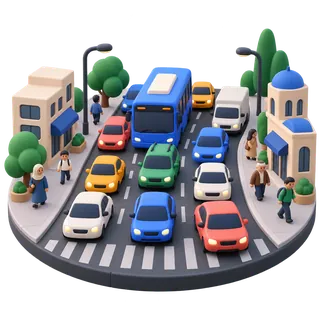
Tirbandlik manzaralari: 8 ta rasm






Traffic so‘zi bilan bog‘liq 6 ta xato
- “There are many traffics.” Traffic sanalmaydigan ot: There’s a lot of traffic yoki The traffic is heavy.
- “Traffic is very strong.” Inglizcha birikma: heavy traffic, light traffic. Strong va big bu so‘z bilan ishlatilmaydi.
- “I was in probka.” I was stuck in a traffic jam yoki I got stuck in traffic.
- “Accident happened on the ring road.” O‘zbek tilida artikl yo‘q, shuning uchun u tushib qoladi: There was an accident on the ring road.
- “Drivers don’t give way to walkers.” Piyoda yo‘lovchi pedestrian: Drivers don’t always give way to pedestrians.
- “The government should make more roads.” Yo‘l build qilinadi: build more roads, widen the roads.
Lexical resource ustunini tekshirish: 7 daqiqalik yozuv
Rasmiy Speaking band descriptors jadvalida to‘rt ustun bor; ikkinchisi Lexical resource, ya’ni so‘z boyligi. Band 7 qatori mazmunan shunday: so‘zlar turli mavzularda moslashuvchan ishlatiladi, kamroq uchraydigan va idiomatik birikmalar paydo bo‘ladi, ba’zi noo‘rin tanlovlar bo‘lsa ham uslub va collocationni his qilish seziladi, kerak bo‘lganda fikr boshqa so‘zlar bilan samarali ifodalanadi. Band 6 da so‘z zaxirasi uzoq gapirishga yetadi, ba’zan so‘z noo‘rin tanlanadi, lekin ma’no tushunarli qoladi.
Traffic mavzusi buni tekshirish uchun qulay, chunki bitta so‘zni qayta-qayta aytish xavfi katta.
- 1 daqiqa. 1, 2, 5 va 8-savollarni qog‘ozga yozing. Telefonda ovoz yozishni yoqing.
- 2 daqiqa. Har savolga 20–30 soniya javob bering. Javoblarni oldindan yodlamang.
- 2 daqiqa. Yozuvni tinglab, traffic so‘zini necha marta aytganingizni sanang. To‘rt martadan ko‘p bo‘lsa, muqobil so‘zlar yetishmayapti: the roads get packed, congestion, rush hour, it’s bumper to bumper.
- 1 daqiqa. Collocationlarni tekshiring: heavy traffic, stuck in traffic, make a U-turn, get a fine. Ruscha so‘z qolgan bo‘lsa (probka, perexod), yuqoridagi jadvaldan inglizchasini oling.
- 1 daqiqa. Eng zaif javobni tanlab, qayta yozib oling.
So‘z boyligini band 7 ga olib chiqish bo‘yicha batafsil reja lexical resource band 7 sahifasida.
Mashq: tirbandlik iboralarini to‘ldiring
So‘zlar: heavy, stuck, rush, honk, crossing, lanes, U-turn, fine
- The traffic is really ___ on Friday evenings.
- We got ___ behind a broken-down bus for twenty minutes.
- It’s almost impossible to find a taxi during ___ hour.
- Some drivers ___ as soon as the light turns green.
- Always cross the road at a pedestrian ___.
- The city needs more cycle ___.
- We missed our turning, so the driver had to make a ___.
- My uncle got a ___ for parking on the pavement.
Javoblar
- 1. heavy (heavy traffic)
- 2. stuck (get stuck behind / in)
- 3. rush (rush hour)
- 4. honk
- 5. crossing (pedestrian crossing)
- 6. lanes (cycle lanes)
- 7. U-turn (make a U-turn)
- 8. fine (get a fine)
Oltitadan ko‘pini to‘g‘ri topgan bo‘lsangiz, so‘zlarni endi o‘z gapingizda ishlating: har biri bilan shahringiz haqida bitta gap ayting. Shahringizni umumiy tasvirlash kerak bo‘lsa, hometown savollari sahifasiga o‘ting.
Bandi bilan shahringizdagi tirbandlik haqida gaplashing
BandMate ilovasida Bandi bilan ovozli suhbatda kundalik yo‘lingiz va shahringizdagi tirbandlik haqida gapirib ko‘rishingiz mumkin: Bandi javobingizdan kelib chiqib keyingi savolni beradi. IELTS Speaking mock testida Part 1 savollariga vaqt bilan javob berasiz va talaffuz bo‘yicha fikr olasiz. Bu fikrlar mashq uchun, rasmiy IELTS bahosi o‘rnini bosmaydi.