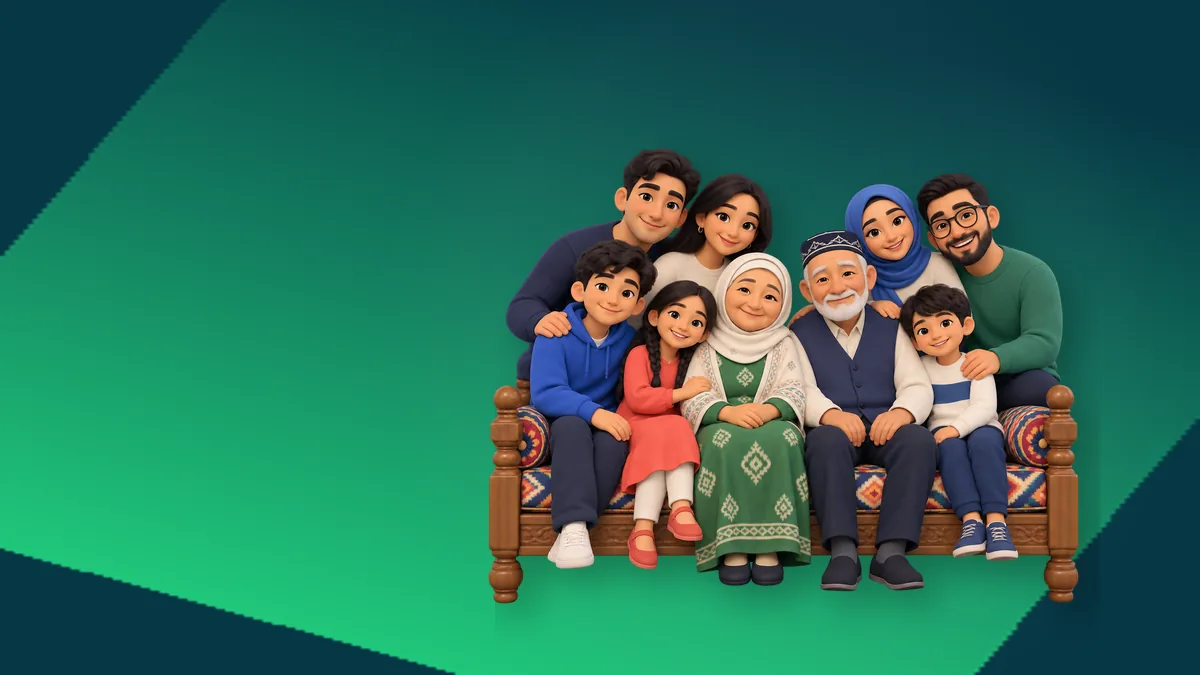
Family savollarida oilangizni ro‘yxat qilib sanab chiqish shart emas. Savolga birinchi jumlada javob bering, keyin bitta odat yoki bitta odam haqida aniq detal qo‘shing: kim bilan yaqinsiz, birga nima qilasiz, qarindoshlarni qachon ko‘rasiz. O‘zbek oilasining o‘ziga xos tomonlari (katta oila, to‘ylar, kattalarga hurmat) javobingizni boshqalarnikidan ajratib turadi, faqat ularni inglizcha tushunarli qilib ayting. Quyida 10 ta mashq savoli, band 6 va band 7+ javoblar, qarindoshlik so‘zlari, tipik xatolar va javobli mashq bor.
Savollar tahririyat tomonidan mashq uchun tuzilgan, real imtihon savollari emas. Band belgilari ham rasmiy baho emas, faqat solishtirish uchun. Part 1 tuzilishi IELTS format sahifasida tushuntirilgan.
Bir eslatma: Speaking testi ingliz tilingizni baholaydi, hayotingizning haqiqatini emas. Oila haqida gapirish sizga og‘ir bo‘lsa, javobni o‘zingizga qulay tarzda soddalashtirishingiz yoki boshqa qarindosh haqida gapirishingiz mumkin.
Qarindoshlarni inglizchada qanday atash
| O‘zbekcha | Inglizcha | Izoh |
|---|---|---|
| aka / uka | older brother / younger brother | elder brother ham to‘g‘ri |
| opa / singil | older sister / younger sister | |
| amaki / tog‘a | uncle | kerak bo‘lsa: my uncle on my father’s side |
| amma / xola | aunt | my aunt on my mother’s side |
| amakivachcha, xolavachcha | cousin | jinsi yo‘q, “cousin brother” demang |
| jiyan | nephew (o‘g‘il) / niece (qiz) | |
| nevara | grandchild, grandson, granddaughter | |
| kelin | daughter-in-law / sister-in-law | kimga nisbatan ekaniga qarab |
| qaynona / qaynota | mother-in-law / father-in-law |



10 ta savol, ikki xil javob
Har bir savolda A javob band 6 atrofida, B javob band 7+ uslubida yozilgan.
1. How many people are there in your family?
Javob A (band 6 atrofida): “There are five people in my family: my father, my mother, my two brothers and me.”
Javob B (band 7+ uslubida): “Five, if you count just the people under our roof: my parents, my two younger brothers and me. But in Uzbekistan ‘family’ usually stretches much further, so if you include grandparents and cousins, I’d need a few minutes to list everyone.”
Imtihonchi nimani eshitadi: B javob raqamni aytib, darhol madaniy farqni ko‘rsatadi. A javob to‘g‘ri, lekin faqat ro‘yxat.
2. Do you live with your family?
Javob A: “Yes, I live with my parents. In Uzbekistan it is normal.”
Javob B: “Yes, and I’m in no hurry to move out. It’s quite common here for young people to live with their parents until they marry, and honestly, coming home to a cooked meal after work is hard to give up.”
Imtihonchi nimani eshitadi: it is normal o‘rniga it’s quite common here for… va hazil bilan shaxsiy sabab.
3. Who are you closest to in your family?
Javob A: “I am close with my mother, because she always helps me and understands me.”
Javob B: “Probably my older sister. She’s only two years older than me, so we went through school almost together, and she’s still the first person I call when something goes wrong, even though she now lives in Namangan with her husband’s family.”
4. What do you usually do together as a family?
Javob A: “We watch TV together and sometimes we go to the park on weekends.”
Javob B: “Dinner is the one fixed thing. However busy the day has been, we all sit down at about eight, and that’s when the real news of the day comes out. On Sundays we often drive out to my uncle’s house on the edge of the city.”
5. Do you look like anyone in your family?
Javob A: “People say I look like my father, because we have the same eyes.”
Javob B: “Apparently I’m the spitting image of my grandfather at my age; when my aunt showed me an old photo of him, even I was surprised. Personality-wise, though, I take after my mum, since we’re both quite stubborn.”
Imtihonchi nimani eshitadi: look like (tashqi ko‘rinish) va take after (fe’l-atvor) farqi to‘g‘ri ishlatilgan.
6. Do you have a big extended family?
Javob A: “Yes, my family is very big. I have many cousins, maybe thirty.”
Javob B: “Huge. My mum is one of seven children, so I have more cousins than I can keep track of. You realise how big it is at weddings, because there are always relatives I’ve never met who seem to know everything about me.”
7. How often do you see your relatives?
Javob A: “I see my relatives on holidays and at weddings, maybe once a month.”
Javob B: “More often than I’d sometimes like, to be honest. There’s a wedding, a birthday or some kind of gathering almost every month, and in our culture skipping one without a good reason is taken quite seriously.”
8. Did you spend a lot of time with your grandparents as a child?
Javob A: “Yes, I spent a lot of time with my grandmother because my parents worked.”
Javob B: “Yes, a lot. Both my parents worked long hours, so my grandmother basically raised me until I started school. She taught me to read and to make somsa, and I think I got my patience from her as well.”
9. Do you prefer spending time with your family or your friends?
Javob A: “I prefer my family, because family is the most important.”
Javob B: “It depends on my mood. With my family I can completely relax and not say a word, which I value after a long week. With friends I’m more likely to try new places, so I need a bit of both.”
Imtihonchi nimani eshitadi: A javob umumiy shior bilan yopiladi. B javob ikki tomonni aniq sabab bilan solishtiradi.
10. Is family important in your country?
Javob A: “Yes, family is very important in Uzbekistan. People respect old people.”
Javob B: “Extremely. Big decisions, from choosing a university to buying a car, are often discussed with parents and even grandparents. Respect for elders is still very strong, although I think younger couples in cities are becoming a bit more independent.”
Imtihonchi nimani eshitadi: old people o‘rniga elders, fikr esa although bilan muvozanatlangan. Bu savol Part 3’ga o‘xshab ketadi, lekin Part 1’da uch jumla yetarli. Chuqurroq muhokama Part 3 family savollari sahifasida.
Oila mavzusida qo‘l keladigan iboralar
| Ibora | Tarjimasi | Misol |
|---|---|---|
| be close to somebody | kimgadir yaqin bo‘lmoq | I’m very close to my younger cousin. |
| take after somebody | xarakteri kimgadir o‘xshamoq | My brother takes after our dad: calm and quiet. |
| the spitting image of | kimningdir aynan o‘zi | She’s the spitting image of her grandmother. |
| extended family | katta oila (qarindoshlar bilan) | Our extended family fills three tables at weddings. |
| bring somebody up | tarbiyalamoq | I was brought up by my grandparents. |
| get on well with | yaxshi chiqishmoq | I get on well with my sister-in-law. |
| move out | alohida yashashga o‘tish | My brother moved out when he got a job in Tashkent. |
| a family gathering | oilaviy yig‘in | Family gatherings usually end with plov. |
| an only child | yolg‘iz farzand | Being an only child is rare in my mahalla. |
Ko‘proq so‘z kerak bo‘lsa, english family vocabulary sahifasida qarindoshlik nomlari misollar bilan berilgan.
O‘zbek va rus tili ta’siridagi xatolar
- He va she aralashishi. O‘zbekcha “u” jinsni ko‘rsatmaydi, shuning uchun “My mother… he works at a school” degan xato tez-tez eshitiladi. Onangiz, opangiz, xolangiz haqida gapirganda har safar she, her ni tekshiring. Bu tinglovchiga eng tez sezilib qoladigan xatolardan biri, chunki gap kim haqida ketayotgani chalkashadi.
- “My parents came to the wedding” (aslida qarindoshlar nazarda tutilgan). Ruscha “родители” = parents (ota-ona), “родственники” = relatives. Tog‘angiz va xolangiz relatives.
- “We are five in my family.” Ruscha “нас пятеро” kalkasi. To‘g‘risi: There are five of us yoki There are five people in my family.
- “My cousin brother.” Cousin ning o‘zi yetarli. Jinsini aytish kerak bo‘lsa: my cousin, he’s…
- “My father is doctor.” Kasb oldidan artikl: My father is a doctor.
- “She is married with my uncle.” To‘g‘risi: married to.
- “I am close with my mother.” Amerikacha ishlatiladi, lekin close to ko‘proq tarqalgan va xavfsizroq.
Mashq tartibi: bog‘lovchilarga e’tibor
- Ro‘yxatdan to‘rtta savol tanlang: 3, 5, 7 va 9.
- Har biriga 20–30 soniya javob bering, telefonda yozib oling. Taymer o‘tib ketsa ham gapni oxiriga yetkazing, lekin yangi fikr boshlamang.
- Yozuvni tinglab, ikki narsani sanang: he/she xatolari va gaplarni bog‘lagan so‘zlar (so, because, although, which, even though).
- Rasmiy Speaking band descriptors dagi “Fluency and coherence” ustunini 6 va 7 darajada o‘qing. Bog‘lovchilar va nutq belgilari haqida nima yozilganiga e’tibor bering, keyin yozuvingizda ular qanchalik moslashuvchan ishlatilganini eshiting. Natijani band raqami bilan emas, izoh bilan yozing.
- Bog‘lovchi eng kam bo‘lgan javobni although yoki which qo‘shib qayta yozib oling.
Part 2’da oila a’zosi haqida kartochka tushsa, 3- va 8-savollardagi hikoyalar tayyor boshlanish bo‘ladi: describe a family member sahifasida davom eting. Do‘stlar haqidagi savollar ham shu tuzilmalarni talab qiladi, ularni friends savollari bilan mashq qiling.
Mashq: bo‘shliqni to‘ldiring
So‘zlar: she, relatives, of, after, to (×2), image, up
- My aunt is a nurse, and ___ works night shifts twice a week.
- There are six ___ us, including my grandmother.
- I take ___ my father: we both love fixing things.
- My older sister is married ___ a doctor from Andijan.
- At every wedding I meet ___ I’ve never seen before.
- My little brother is the spitting ___ of my uncle.
- I was brought ___ in a small town near Jizzakh.
- I’m closest ___ my grandmother, because she lived with us.
Javoblar
- 1. she (he emas)
- 2. of (There are six of us)
- 3. after (take after)
- 4. to (married to)
- 5. relatives (parents emas)
- 6. image
- 7. up (bring up → brought up)
- 8. to (close to)
Birinchi yoki beshinchi gapda xato qilgan bo‘lsangiz, bu tilingiz emas, ona tilingizning odati. Oila a’zolaringiz haqida beshta qisqa gapni ovoz chiqarib ayting va har birida olmoshni tekshiring.
BandMate bilan mashq
BandMate ilovasida Bandi bilan family kabi Part 1 mavzularida ovozli suhbat qilishingiz mumkin. Bandi savol beradi, “Who are you closest to?” kabi davom savollari qo‘yadi, talaffuz va javob bo‘yicha fikr bildiradi. Oila haqida oddiy matn tuzishdan boshlamoqchi bo‘lsangiz, oilam haqida inglizcha matn sahifasi yordam beradi. AI fikri va namuna javoblar rasmiy IELTS bahosi emas.