Rasmni tasvirlashda to‘rt qadam bor: 1) umumiy ko‘rinish (bir gapda: rasmda nima bor), 2) tafsilotlar (joy iboralari bilan: on the left, in the background), 3) taxminlar (She might be…, It looks like…), 4) fikringiz (I think…, It reminds me of…). Odamlar nima qilayotganini Present Continuous bilan aytasiz: He is sitting, they are eating. Shu tartibda 6–8 gap maktab uchun, 45–60 soniyalik nutq esa imtihon mashqi uchun yetarli.
Quyida har bir qadam uchun iboralar, BandMate darslaridagi ikki rasm asosida ikki namuna va mustaqil mashq uchun uchinchi rasm bor.
1-qadam. Umumiy ko‘rinish: bitta gap
Tinglovchiga avval "katta rasm"ni bering. Mayda narsadan boshlasangiz, u nima haqida gap ketayotganini tushunmaydi.
- This picture shows an old woman and a boy on a bench.
- It’s a photo of a family meal.
- In this picture I can see a crowded bus.
- The picture is about people going to work.
Bitta gap, ko‘pi bilan ikkita. In the picture I see… ni har gapda takrorlamang.
2-qadam. Tafsilotlar: joy iboralari
| Ibora | Tarjima | Misol |
|---|---|---|
| in the foreground | oldingi planda | In the foreground there is a big table. |
| in the background | orqa planda | In the background we can see mountains. |
| in the middle / in the centre | o‘rtada | In the middle there is a round bread. |
| on the left / on the right | chap / o‘ng tomonda | On the left, an old woman is knitting. |
| at the top / at the bottom | tepada / pastda | At the top of the picture there’s a teapot. |
| in the top left corner | yuqori chap burchakda | In the top left corner I can see a hand. |
| next to / beside | yonida | The boy is sitting next to his grandmother. |
| behind / in front of | orqasida / oldida | A man is standing behind her. |
| between | orasida | The salad is between the bread and the tea. |
Diqqat: rasm haqida gapirganda in the picture deyiladi, on the picture emas. Chap va o‘ng esa on: on the left, in the left emas.
Harakatni Present Continuous bilan tasvirlang: is holding, are smiling, is pouring. Shakllanishini unutgan bo‘lsangiz, Present Continuous qoidasi sahifasiga qarang.
3-qadam. Taxminlar: rasmda ko‘rinmaydigan narsa
Yaxshi javobni oddiy javobdan ajratadigan qism shu. Rasmda kim, qayerda, nega, qanday his qilayotganini taxmin qiling. Qanchalik ishonchingiz borligiga qarab ibora tanlang:
| Ishonch | Iboralar | Misol |
|---|---|---|
| deyarli aniq | must be, clearly | They must be a family. |
| ehtimol | probably, I think, I’d say | It’s probably a holiday. |
| balki | might, may, could, perhaps, maybe | He might be listening to music. |
| tashqi ko‘rinishga qarab | looks, looks like, seems | She looks happy. It looks like a park. |
| sabab bilan | judging by…, because… | Judging by their clothes, it’s cold. |
Grammatik tuzoq: looks dan keyin sifat keladi (She looks tired), looks like dan keyin ot yoki gap (It looks like a wedding). Might dan keyin to qo‘yilmaydi: ❌ He might to be → ✅ He might be. Ehtimollik fe’llari haqida batafsil: may va might.
4-qadam. Fikr va shaxsiy bog‘lanish
Bir-ikki gap bilan tugating:
- I like this picture because it feels warm and friendly.
- It reminds me of my grandmother’s house in Andijan.
- I think the photographer wanted to show how different generations are.
1-namuna: buvi va nabira (B1, taxminan 50 soniya)
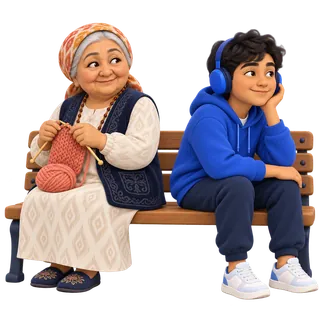
This picture shows an old woman and a teenage boy sitting on a wooden bench. On the left, the woman is knitting something pink, maybe a scarf or a sweater. She’s wearing a colourful headscarf and a dark embroidered vest, and she’s smiling at the boy. On the right, the boy is wearing a blue hoodie and big blue headphones. He’s resting his chin on his hand and looking away, so he might be listening to music or just daydreaming. The background is plain, so we can’t see where they are, but judging by the bench, it could be a park or a quiet street in a mahalla. They are probably grandmother and grandson. I like this picture because it shows two generations: they are very different, but they are still spending time together.
Tahlil. Birinchi gap umumiy ko‘rinish. Keyin chapdan o‘ngga tartib bilan tafsilot (On the left… On the right…). Uchta taxmin bor: nima to‘qiyapti (maybe), bola nima qilyapti (might), qayerda (judging by… could). Oxirida shaxsiy fikr. Taxminan 140 so‘z, sekin gapirganda bir daqiqaga yaqin.
2-namuna: bayram dasturxoni (A2, maktab uchun)
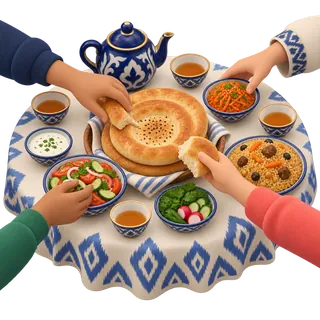
This is a picture of a table with a lot of food. It is a view from above. In the middle there is a big round bread on a plate. Somebody is breaking a piece of bread. There is plov with meat and carrots on the right and two salads on the left. At the top there is a blue and white teapot and some cups of tea. We can only see people’s hands, so I think five or six people are sitting at the table. It looks like a family meal, maybe on a holiday like Navruz. I like this picture because it reminds me of Sunday lunch at my grandparents’ house.
Tahlil. Gaplar qisqa, asosiy tuzilma there is / there are va Present Continuous. Taxmin sodda so‘zlar bilan (I think, It looks like, maybe). 7–8-sinf og‘zaki javobi yoki 80–100 so‘zli yozma ish uchun mos.
Maktabda va imtihonda rasm tasvirlash farqi
Maktabda o‘qituvchi odatda rasmga qarab bir necha gap aytishni yoki yozishni so‘raydi: bu yerda to‘liq, to‘g‘ri gaplar va there is/are muhim. CEFR (Multilevel) Speaking imtihonida esa rasmlar bilan ishlaydigan qism bor va vaqt cheklangan; u yerda bitta rasmni uzoq tasvirlash emas, rasmlarni taqqoslash va fikr bildirish talab qilinadi. Bu uchun alohida tayyorlangan ikki rasmni taqqoslash sahifasidagi 45 soniyalik tuzilmadan foydalaning. Imtihon qismlari va vaqtini doim rasmiy manbadan tekshiring: Multilevel imtihon formati.
Rasm tasvirlaganda eng ko‘p uchraydigan 6 xato
| Xato | To‘g‘ri |
|---|---|
| On the picture I see a boy. | In the picture I can see a boy. |
| He is sit on a bench. | He is sitting on a bench. |
| There is two people. | There are two people. |
| In the left there is a woman. | On the left there is a woman. |
| She maybe is tired. | She may be tired. / Maybe she is tired. |
| A boy, a woman, a bench, a bag. | A boy and a woman are sitting on a bench. (ro‘yxat emas, gap) |
Beshinchi xato ayniqsa ko‘p: maybe bitta so‘z va gap boshida keladi; may be ikki so‘z, fe’l o‘rnida turadi.
Mashq: bo‘sh joyni to‘ldiring
Ro‘yxatdan tanlang: shows, on the right, in the background, might, looks, judging by, next to, reminds me of.
1. This picture ___ a busy street in Tashkent.
2. ___, a man is selling fruit.
3. ___ we can see some tall buildings.
4. The girl ___ tired.
5. She ___ be going home after school.
6. ___ their coats, it’s winter.
7. A little boy is standing ___ his father.
8. This picture ___ my first trip to Samarkand.
Mustaqil tasvir. Quyidagi rasmni 4 qadam bo‘yicha 6–8 gapda tasvirlang, kamida ikkita taxmin bilan.

Javoblar
1. shows 2. On the right 3. In the background 4. looks 5. might 6. Judging by 7. next to 8. reminds me of
Mustaqil tasvir uchun namuna: This picture shows a lot of people in a crowded bus or metro carriage. They are all standing and holding a metal bar above their heads. In the middle there is a young woman in a white headscarf, and behind her an old man in a doppi is holding the bar too. On the left, a young man with a backpack is wearing an earphone, so he might be listening to music. On the right, a man in a suit and tie is probably going to the office. It must be the rush hour, because there are no free seats. It reminds me of the Tashkent metro at eight in the morning.
Rasmga qarab gapirishni BandMate’da mashq qilish
Rasm tasvirlash yozuvda oson, ovoz bilan va vaqt cheklovida qiyin. BandMate ilovasida darslardagi rasmlarga qarab javob berasiz, Bandi esa qo‘shimcha savol beradi (Why do you think he looks tired?). Suhbatdan keyin ilova grammatika va talaffuz bo‘yicha izoh ko‘rsatadi. Bu izohlar mashq uchun, rasmiy imtihon bahosi emas. IELTS’ga tayyorlanayotgan bo‘lsangiz, surat haqidagi cue card uchun describe a photo sahifasiga o‘ting.
Bugungi qadam: telefoningizdagi oxirgi oilaviy suratni oching va uni 4 qadam bo‘yicha ovoz chiqarib, telefonga yozib oling. Keyin tinglang: taxmin iboralaridan nechtasini ishlatdingiz?
BandMate’ni Google’da afzal manba qiling